Executive Summary
This report chronicles the extraordinary pace of scientific discoveries and demonstrates how sustained federal support has expanded treatment options, improved survival, and enhanced quality of life for patients with cancer.
Home > AACR Cancer Progress Report > AACR Cancer Progress Report 2026: Contents
This report chronicles the extraordinary pace of scientific discoveries and demonstrates how sustained federal support has expanded treatment options, improved survival, and enhanced quality of life for patients with cancer.

To continue the remarkable progress against cancer, the AACR calls on Congress to provide robust, sustained, and predictable annual funding increases for NIH, NCI, FDA, and CDC in FY 2027 and beyond.
Between July 1, 2025, And June 30, 2026, FDA approved 11 new anticancer therapeutics and 5 previously approved therapeutics for treating new cancer types.
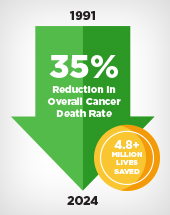
The overall cancer death rate in the U.S. declined by 35% between 1991 and 2024, translating into more than 4.8 million cancer deaths averted. However, substantial inequities in the burden of cancer persist across many segments of the U.S. population.
Cancer is a collection of diseases in which some of the body’s cells acquire changes that allow them to grow uncontrollably and spread to other parts of the body.

40% of all cancers in the U.S. are associated with modifiable risk factors, including cigarette smoking, excess body weight, alcohol consumption, UV radiation exposure, and unhealthy diet.

Cancer screening refers to checking for cancer, or abnormal cells that may become cancer, in people who do not have symptoms of the disease. Routine screening helps save and improve lives by detecting cancer at an early stage when treatment may be curative.
Novel approaches to surgery, radiotherapy, chemotherapy, molecularly targeted therapy, and immunotherapy—the five pillars of cancer treatment—are saving lives. While these advances can transform patient care, much work is needed to ensure all patients have access to these treatments.

Cancer survivors face a multitude of physical, emotional, and financial challenges. Effective survivorship care requires coordinated approaches that help survivors access the resources needed to support their long-term health and quality of life.

AI approaches are accelerating scientific discovery, streamlining drug development, improving clinical decision-making, and enabling more personalized cancer care, while liquid biopsies, cancer vaccines, and RNA medicines are transforming cancer detection, prevention, and treatment.

Sustained federal investment in cancer research drives scientific discovery and innovation that improve outcomes for patients. Science-driven policies can expand access to care, strengthen public health programs, reduce cancer disparities, and ensure that progress reaches every patient.
Through its programs and services, AACR fosters cancer research; accelerates the dissemination of new research findings; promotes science education and training; and advances the understanding of cancer etiology, prevention, diagnosis, and treatment throughout the world.

Decades of federally supported research have transformed cancer prevention, detection, treatment, and survivorship care, but these gains are now at risk. Growing uncertainty surrounding funding for medical research threatens the nation’s ability to innovate and deliver future breakthroughs.

Keith Flaherty, MD, FAACR, serves as the chair of the Steering Committee for the AACR Cancer Progress Report 2026.
Your donation to the American Association for Cancer Research helps our more than 65,000 members worldwide drive progress against cancer.
Donate Today