The Honorable James Walkinshaw
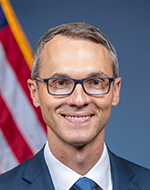
U.S. Representative for Virginia’s 11th District
You served alongside Congressman Gerald (Gerry) E. Connolly for many years before succeeding him. How has his fight with cancer, and his example, shaped your commitment to this issue?
Congressman Connolly taught me that public service is about turning even your hardest moments into
opportunities to help other people. I had the privilege of serving as Gerry’s Chief of Staff for more than a decade, and even after his diagnosis, he never stopped fighting for his constituents or looking for ways to improve people’s lives.
Helping carry the Gerald E. Connolly Esophageal Cancer Awareness Act, his final bill, across the finish line was deeply personal for me. Gerry understood that early detection can save lives, and he wanted future patients and families to benefit from greater awareness and better screening. The legislation directs the Government Accountability Office to examine esophageal cancer screening and care under the Federal Employees Health Benefits Program, turning Gerry’s personal battle into lasting public policy. His example reinforced something I have always believed: Our responsibility in public office is to leave things better than we found them. When families face a cancer diagnosis, Congress should do everything possible to support research, improve early detection, and remove barriers to care.
How has that experience informed your view of why federal investment in cancer screening, prevention, and research matters?
Cancer touches nearly every family in America. It reminds us that public policy is not abstract. It is deeply personal. Federal investment in prevention, screening, and research has transformed what was once impossible into everyday medical practice. Patients are living longer because of decades of research supported by institutions like the National Institutes of Health (NIH) and the National Cancer Institute (NCI). Early detection saves lives, improves outcomes, and often reduces the long-term cost of treatment.
I believe the government has an important role in supporting scientific research and making breakthroughs. When we invest in biomedical research, we invest in hope for patients waiting for a breakthrough, families searching for answers, and future generations who deserve better treatment options. That is why I supported full funding for NIH and the National Science Foundation.
Why is protecting and supporting the federal scientific workforce essential to the fight against cancer?
Northern Virginia is home to thousands of dedicated public servants, including scientists, physicians, and researchers whose work improves lives across the country. When people talk about NIH, NCI, or the US Food and Drug Administration, they often think about institutions. I think about the people. They are the researchers designing clinical trials, reviewers evaluating promising therapies, scientists advancing our understanding of cancer biology, and public servants moving discoveries from the laboratory to patients. For many of them, their work is a lifelong commitment to the cause. These professionals are the reason progress happens. Undermining the federal scientific workforce means slowing research, delaying innovation, and ultimately delaying hope for patients and families.
What is your message to the scientists, physicians, and researchers working every day to make progress against cancer?
Thank you. Thank you for choosing careers dedicated to serving others. Thank you for the long hours in laboratories, hospitals, and clinics. Thank you for every clinical trial, research paper, difficult diagnosis delivered with compassion, and breakthrough that gives patients another chance. Progress against cancer has never happened by accident. It has happened because generations of scientists, physicians, nurses, researchers, and public servants refused to stop searching for better answers.