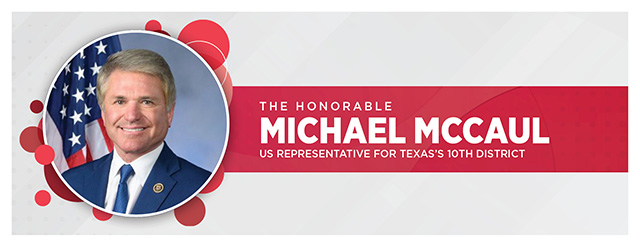
The Honorable Michael McCaul
Pediatric cancer has profound effects on children and their families. Could you share how it has impacted you personally, or someone close to you?
“I first learned about cancer in fourth grade, when I noticed my best friend’s hair falling out, and he told me he was really sick. I attended his funeral one month later. While it’s impossible for a nine-year-old to really make sense of that, I knew I wanted to keep it from happening to other kids.”
How has that experience influenced your work in Congress?
“I founded the Childhood Cancer Caucus as soon as I joined Congress because I noticed kids with cancer didn’t have a voice in Washington. That’s why I don’t just work to pass legislation, but I also hold summits and opportunities for children fighting this brutal disease to visit D.C., make their voices heard, and show the world their incredible strength. Members of Congress may be able to say no to me, but they can’t say no to these precious kids, who need us to fight on their behalf.”
Which legislative or policy accomplishments are you most proud of that help address the needs of pediatric cancer patients and their families?
“I’m proud to have authored and passed several bills that are currently saving thousands of young lives. My Creating Hope Act, for example, established the Priority Review Voucher program, which was used by a dear friend of mine—Dr. Allison from MD Anderson in my home state of Texas—to obtain FDA approval for a groundbreaking treatment called CAR-T immunotherapy. Sixty-three vouchers have so far been awarded for rare pediatric diseases treatments since the bill’s enactment.”
“This Congress, I’m working to reauthorize this crucial voucher program through my Give Kids A Chance Act. This bill would also authorize the FDA to direct companies to study combination drugs and therapies in pediatric trials—giving children the same chance as adults to beat cancer.”
How has the tremendous bipartisan support for pediatric cancer research helped make an impact?
“It’s truly inspiring to see congressmembers from both sides of the aisle come together to work on such an important topic. Without bipartisan support, none of our caucus’ achievements would have been possible. My Give Kids A Chance Act currently has nearly 270 cosponsors, making it one of the most bipartisan bills in Congress, and it recently passed the House Energy and Commerce Committee with a rare, unanimous vote of 47-0. I’m hopeful this bipartisan momentum will help bring it to the House floor for a vote in the coming weeks.”
Over the next five years, what do you see as the best opportunities for further improving outcomes for children with cancer in the U.S., particularly in rural or underserved communities?
“Telehealth will be vital in reaching our rural and underserved communities, allowing them to visit and keep up with doctors from afar. The Health Resources and Services Administration has been working to expand and improve broadband connections, so specialists can use technology like artificial intelligence to provide care without being in the same room. Additionally, President Trump recently issued an Executive Order that doubles the funding for the Childhood Cancer Data Initiative, which uses AI to advance research and treatments. My current bill, the Give Kids A Chance Act, would also help drug companies test developing combination drug therapies for children, and AI could play a large role in creating those future treatments.”
What message would you like to share with the scientists, clinicians, and patient advocates working every day to make progress against pediatric cancer?
“Keep up the good work! Each year at my Childhood Cancer Summit, I bring in top scientists and researchers to share the exciting work being done in the childhood cancer space, and I’m never disappointed. From new cancer vaccines to natural killer cell therapy, significant breakthroughs are being made, and I am confident we are not far away from beating this heartbreaking disease—once and for all.”
Return to Section: Advancing Pediatric Cancer Research and Patient Care Through Evidence-Based Policies